


The U.S. Environmental Protection Agency (EPA) recently updated its guidance on a question that gets asked all the time: “Should you have the air ducts in your home cleaned?” If you’re a professional duct cleaner, this isn’t just a consumer article, it’s a credibility booster, a sales tool, and a checklist you can build your process around.
Why this EPA update matters to your business
Homeowners are doing more research than ever. And when they land on a .gov page, it carries weight.
Use this article to:
- Set expectations (and avoid the “$99 whole-house special” comparison game)
- Educate customers on when cleaning is actually warranted
- Show what professional duct cleaning includes- beyond waving a shop vac near a register
If you lead with facts and a real process, you win.
EPA’s “as-needed” triggers (aka: when homeowners should call you)
The EPA says homeowners should consider duct cleaning if:
- There is substantial visible mold growth inside hard surface ducts or on other HVAC components
- Ducts are infested with rodents or insects
- Ducts are clogged with excessive dust/debris and particles are actually being released into the home through supply registers
Pro tip: the EPA also notes that if any of these conditions exist, it usually points to an underlying cause that needs to be corrected- or the problem will come right back.
What the EPA says a duct cleaning service provider should do
This is the section every legit contractor should print, highlight, and keep in the truck.
According to the EPA, if a homeowner chooses duct cleaning, the service provider should:
- Protect the home (furniture, carpeting, and surfaces) during the work
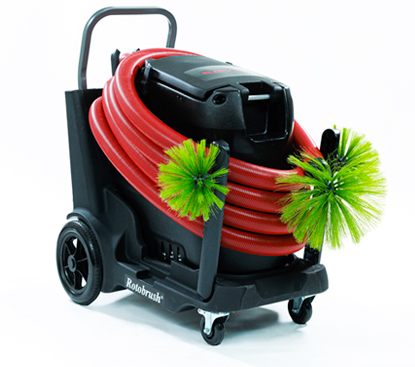
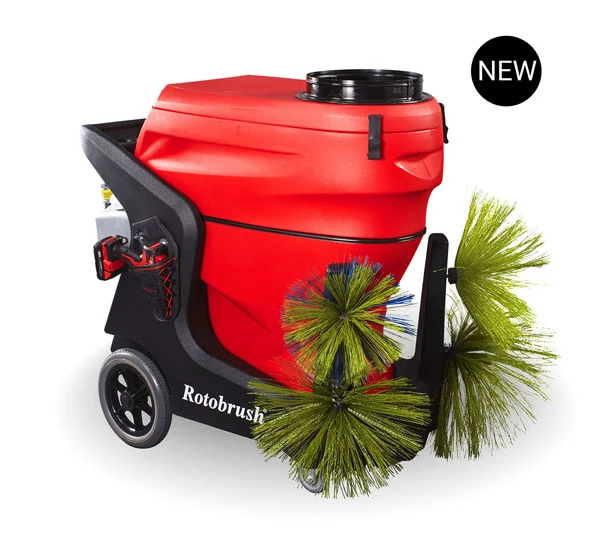
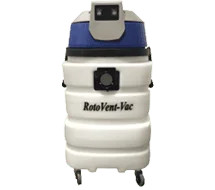
- Use vacuum collection equipment that exhausts outdoors or uses HEPA filtration if exhausting indoors
- Clean and remove debris so it doesn’t enter the occupied space
- Clean all components of the heating and cooling system- not just the ducts (think: supply/return ducts, registers, grilles, diffusers, coils, drain pans, fan motor and housing, air handling unit housing)
- Ensure the system is visibly clean when finished
Translation: a “real” duct cleaning is a system cleaning, not a quick duct-only drive-by.
What consumers should watch out for (and how you can stand out)
The EPA is clear: a poor-quality cleaning can actually create indoor air problems.
They warn that:
- An inadequate vacuum collection system can release more dust and contaminants than leaving the ducts alone
- A careless or undertrained provider can damage ducts or HVAC components, potentially increasing energy costs or leading to expensive repairs
So how do you separate yourself?
- Show your process before you start
- Explain what you’ll clean (all components)
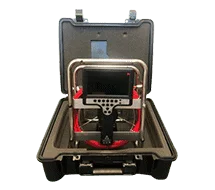
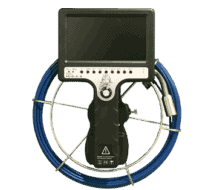
- Use visual proof (before/after photos or video inspection)
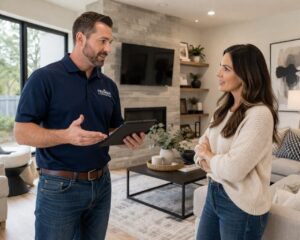
- Walk the homeowner through results at the end
When you lead with transparency, you don’t have to “sell.” The work sells itself.
How homeowners can verify you did a thorough job
The EPA says the best verification is a thorough visual inspection.
They recommend:
- Reviewing a post-cleaning consumer checklist with the provider before work begins
- After the job, asking to see each component to confirm the cleaning was performed satisfactorily
- If any checklist item is “no,” the homeowner should request corrections until everything is “yes”
If your team is doing it right, this level of accountability isn’t scary- it’s a competitive advantage.
How to use the EPA guidance in your marketing (without sounding like a textbook)
Try these simple plays:
- Add a “What the EPA says” section on your duct cleaning service page
- Turn the EPA’s “what to expect” bullets into a customer-facing checklist you hand out on-site
- Create a short video: “3 reasons the EPA says duct cleaning makes sense”
- Use before/after documentation as proof of thoroughness (and trust)
You’re not just cleaning ducts- you’re setting the standard for improved indoor air quality.
Read the EPA’s updated guidance
Here’s the full article: https://www.epa.gov/indoor-air-quality-iaq/should-you-have-air-ducts-your-home-cleaned